by Danny Donovan
When it comes to digital marketing, few debates are more common—or more important—than Google Ads vs Facebook Ads. Both platforms offer unique strengths and powerful targeting tools, but they function in fundamentally different ways. If you’re trying to figure out where to invest your advertising dollars, understanding the differences between Google Ads vs Facebook Ads is important. Each platform excels in different scenarios and can serve different goals based on your audience, budget, and campaign objectives.
We break down the comparison of Google Ads vs Facebook Ads, focusing on targeting capabilities, cost-per-acquisition, and ideal use cases to help you determine which is right for your business.
Before diving into a head-to-head comparison, it helps to understand what each platform does.
Google Ads (formerly known as AdWords) is a pay-per-click (PPC) platform where advertisers bid on keywords so that their ads appear in Google’s search results or across its Display Network.
Facebook Ads are paid social advertisements that appear in users’ news feeds, Stories, Marketplace, and more, based on demographic, interest, and behavioral targeting.
At a high level, Google Ads is more intent-driven—users are actively searching for something, while Facebook Ads is more discovery-driven…users aren’t looking for you, but you can find them based on who they are and what they like.
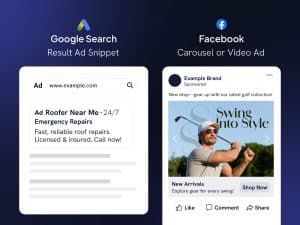
At a high level, the key distinction comes down to search vs social, or intent vs discovery.
Google Ads operates in the world of search user intent is explicit. Someone typing “best running shoes for flat feet” is signaling strong purchase intent.
Facebook Ads lives in the realm of social, where discovery is king. Users scroll through content, and ads appear in the flow, igniting interest through visuals, storytelling, or singular value propositions.
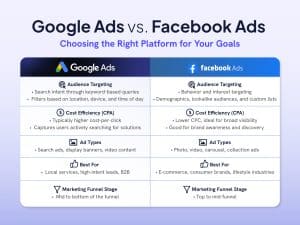
Google Ads Targeting: Google is incredibly powerful when it comes to intent. You can target users based on what they’re actively searching for, which is invaluable for bottom-of-the-funnel conversions. Search ads reach people at the moment they’re looking for your product or service. You can also narrow down by location, device, time, and even remarketing lists.
Facebook Ads Targeting: Facebook’s strength lies in its ability to target users based on demographics and behaviors. Want to reach 35-year-old fitness enthusiasts living in Boston who enjoy meal-prep services? Facebook makes it easy. Its algorithm is built to find patterns based on user behavior, interests, and social activity. You can also create Custom Audiences and Lookalike Audiences to expand your reach to similar users.
One of the biggest advantages of Google Ads is keyword/search-based targeting. You bid on relevant keywords, meaning your ads are shown exactly when someone is looking, signaling need or readiness to purchase. You can layer in location, device, time of day, and even audience lists for remarketing.
By contrast, Facebook Ads relies on powerful behavioral and audience-based targeting. You can reach users based on:
This makes Facebook ideal for cultivating interest before potential customers even know they have a need.
Winner: Tie
Choose Google Ads if you want to target people based on what they need right now.
Choose Facebook Ads if you want to reach people based on who they are and what they like.
Google Ads CPA: Costs can vary widely depending on your industry and keywords. Legal, financial, and healthcare industries can see high cost-per-click (CPC) rates—sometimes $10 or more per click. However, because you’re reaching people with clear purchase intent, the return on investment (ROI) can still be strong.
Facebook Ads CPA: Typically, Facebook Ads have a lower CPC, sometimes less than $1. However, the users you’re reaching aren’t necessarily ready to buy, so your conversion rates might be lower. Still, Facebook is often more affordable for top-of-funnel campaigns that focus on brand awareness, engagement, or list building.
Google Ads vs Facebook Ads Cost: What’s More Affordable?
Both platforms operate on CPC (cost‑per‑click) and CPA (cost‑per‑acquisition), but benchmarks vary across industries.
On Google Ads, especially in competitive verticals (legal, finance), CPCs can run $50–$100 per click. Niche or local keywords often cost under a dollar.
On Facebook, average CPCs are typically $1–$3, though CPAs for qualified leads can range between $50–$100 depending on industry.
Remember, CPC alone isn’t everything—what truly matters is CPA. A higher CPC on Google that converts at 10% might be more cost-effective than a lower CPC on Facebook that converts at 1%.
Winner: Depends on Your Funnel
Facebook Ads win for brand awareness and low-cost clicks.
Google Ads wins for high-intent conversions, even if CPC is higher.
Google Ads: Search ads are mostly text-based, although Display Network and YouTube campaigns allow image and video formats. These ads are great for targeting specific search terms, but you have limited space for creative storytelling.
Facebook Ads: This is where Facebook shines. Video, carousels, Stories, Reels, interactive polls—Facebook allows for visual storytelling in ways Google simply can’t match. If your product needs to be seen to be appreciated, Facebook (and Instagram) give you more room to impress.
Which Platform Offers More Creative Freedom?
Google Ads is streamlined with text-based ads and Shopping feeds, but also supports responsive display ads, image banners, and video ads via YouTube. There’s less room for bold visuals and artistic storytelling, but you can fine-tune headlines, descriptions, and dynamic features.
Facebook Ads, however, is a visual playground:
This gives brands more creative flexibility to experiment with rich visuals, interactive experiences, and storytelling, but it demands strong visuals and craft to stand out in users’ feeds.
Winner: Facebook Ads
For creative freedom and engaging content formats, Facebook is a better choice.
Ideal Use Cases: Where Each Platform Excels
Use Google Ads if:
Use Facebook Ads if:
| Scenario | Ideal Platform | Why |
|---|---|---|
| High-intent purchase (e.g., “roofing companies near me”) | Google Ads | Targets those actively seeking a solution |
| Product discovery & brand awareness | Facebook Ads | Reaches broader audiences through engaging content |
| E-commerce via price comparison | Google Shopping | Captures users in purchase mode |
| Re-engagement and remarketing | both | Google for search/Shopping; Facebook for visual re-targeting |
| B2B lead generation | both | Facebook for awareness; Google for search-driven inquiries |
| Local brick-and-mortar store campaigns | Google Ads Express | Integrates with Maps/Google My Business |
Here’s a secret: you don’t have to choose just one. Many successful businesses run Google Ads and Facebook Ads in tandem. Use Google to capture search intent and drive quick conversions. Use Facebook to build awareness, engage audiences, and retarget users who didn’t convert.
You can also use insights from one platform to improve performance on the other. For example, top-performing keywords from Google can inform your Facebook copy, and high-performing audience segments from Facebook can help fine-tune your Google Display campaigns.
A Hybrid Ad Strategy
You don’t have to choose. Both platforms complement each other beautifully.
Top of funnel (Awareness): Use Facebook to introduce your brand, scope out interest, and collect initial data.
Middle of funnel (Consideration): Add Google Display ads to boost visibility and remarket.
Bottom of funnel (Conversion): Use Google Search and Shopping to capture users primed for action.
This hybrid approach ensures no audience is missed, maximizing ROI by guiding users through each stage with the most effective touchpoint
Use this decision matrix to guide your path:
Need immediate conversions from search demand? ➜ Google Ads
Launching a new product or growing awareness? ➜ Facebook Ads
Limited budget (<$1k/month)? ➜ Start with Facebook (lower CPCs, broader targeting)
Competitors dominate Google for your keywords? ➜ Use Facebook to build social proof and remarket
Balanced mix across funnel? ➜ Go with both—use awareness on Facebook, intent capture on Google
So, Google Ads vs Facebook Ads—which is better? It depends on your goals, budget, and the behavior of your target audience. If you’re ready to generate leads quickly based on user intent, Google is your best bet. If you’re looking to create brand buzz, grow a community, or introduce your product to new audiences, Facebook has the upper hand.
Still not sure where to start? At Dsquared Media, we help brands build smart, data-driven advertising strategies that combine the best of both platforms.

Make your business vision a reality by giving your brand the competitive edge it needs with our branding and strategy consulting services. Our blend of creative skill and marketing experience is specifically tailored to help businesses define, refine, and elevate their brand identity. Through in-depth market analysis, consumer research, and creative brainstorming sessions, our team of expert consultants collaborate closely with clients to develop brand narratives and strategic positioning that resonate with their target audiences.