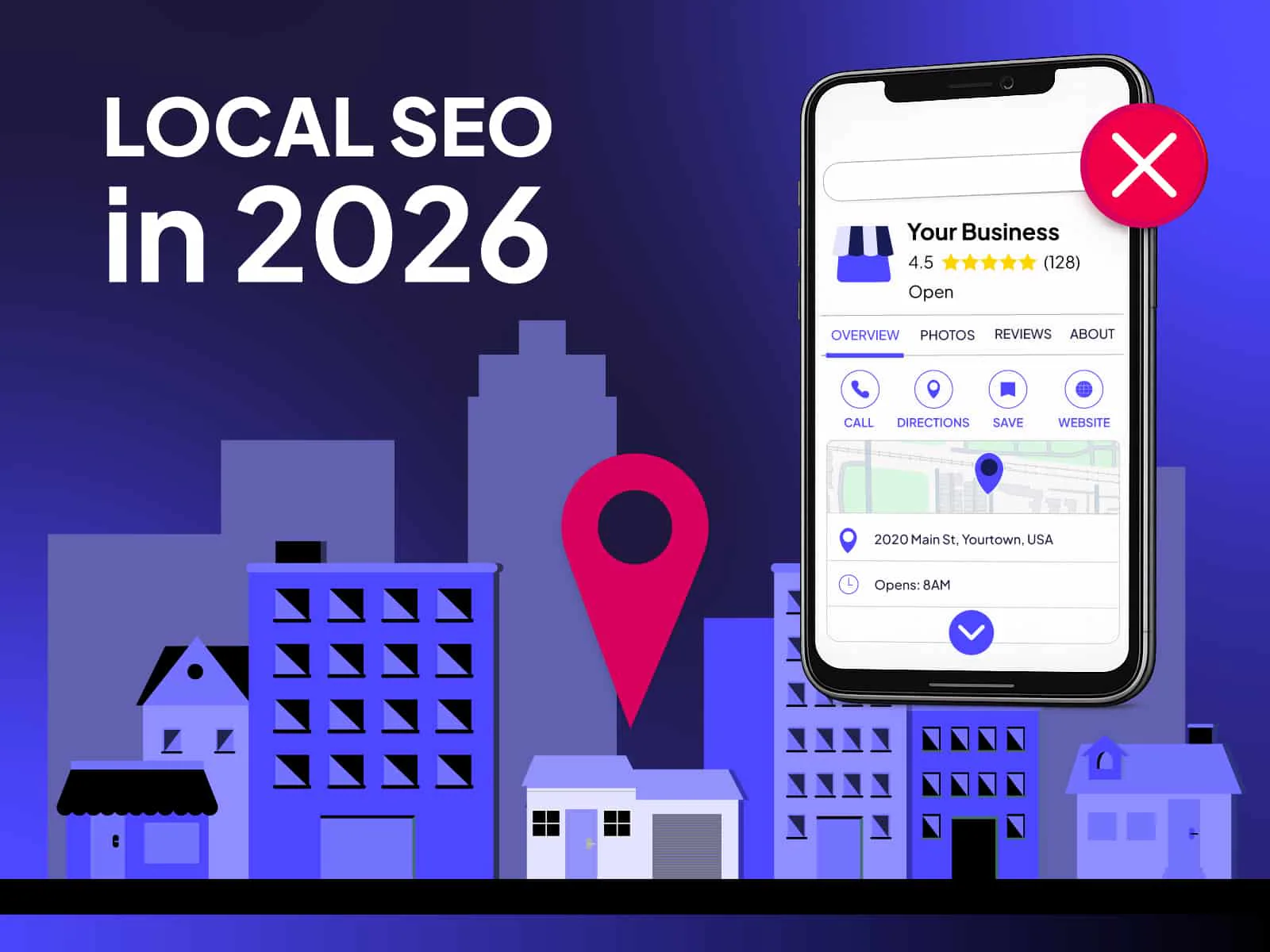

Picture this: you’re a small business owner who takes your Google Business Profile seriously. You update your hours, respond to every review within 24 hours, upload fresh photos weekly, and post updates regularly. You’ve done everything the tutorials told you to do. And yet, somehow, a competitor with a sparse profile and fewer reviews keeps showing up above you in local search results.
The truth is, your Google Business Profile is doing its job. The problem is that local search in 2026 expects much more than a well-maintained profile. Google pulls signals from across the web to decide which businesses deserve visibility, and if your strategy begins and ends with GBP, you’re only showing Google a fraction of what it needs to see.
How Local Search Has Evolved Beyond the Profile-First Approach
For years, Google Business Profile (previously called Google My Business) was the centerpiece of local SEO advice, and for good reason. When Google introduced its local pack, the three-business block that appears at the top of local search results, having a complete and active profile gave businesses a meaningful edge. Most small businesses weren’t optimizing their profiles at all, so those who did saw quick, noticeable results.
But Google’s algorithm has matured considerably. Today, it evaluates local relevance using three core factors: relevance (how well your business matches what someone searched for), distance (how close you are to the searcher), and prominence (how well-established and trusted your business appears across the web). That third factor, prominence, is where most businesses fall short, and it’s the one least influenced by your Google Business Profile optimization alone.
Prominence is built from signals that exist outside of Google’s own ecosystem. It includes the quality and depth of your website, the consistency of your business information across directories and listing platforms, the volume and diversity of your reviews on third-party sites, the backlinks pointing to your domain from locally relevant sources, and the content you’ve published that connects your business to specific geographic areas and topics. Google’s own documentation acknowledges that web results and local results are interconnected, meaning a strong website directly supports your local pack visibility.
Understanding the importance and benefits of local SEO beyond just your profile is the first step.
Your Website Does the Heavy Lifting That GBP Cannot
Your website is where Google goes to understand what your business actually does, who it serves, and whether it’s a credible local authority. If your website is thin or generic, it undermines your profile performance.
One of the most impactful things a local business can do is create location-specific landing pages. If you serve multiple cities or neighborhoods, a single homepage with a general service description isn’t enough. Google needs to see dedicated pages that speak directly to those locations, pages that explain what you do in that area, reference local landmarks or neighborhoods naturally, and answer the questions people in that area are actually searching for. This kind of content writing helps Google connect your business to specific geographic queries in a way that no GBP post ever could.
Schema markup is another area where most small business websites fall short. Schema is a type of structured data added to your website’s code that helps search engines understand the context of your content. For local businesses, implementing LocalBusiness schema communicates your name, address, phone number, business category, and service area directly to Google in a format it can read clearly.
Mobile performance matters more than many business owners realize. Local searches happen overwhelmingly on mobile devices, often from people who are actively looking for a nearby business right now. If your website loads slowly, displays poorly on a phone, or buries your contact information, you’re losing those visitors before they ever have a chance to become customers. Google also factors page experience signals into rankings, so a slow or frustrating mobile experience can quietly suppress your visibility.
A thorough website audit can reveal exactly where your site is falling short.
Citations and Directories: The Unglamorous Work That Still Matters
Citation consistency refers to how accurately and consistently your business name, address, and phone number (commonly called NAP) appear across the web. Every directory listing, every mention on a local chamber of commerce website, every entry in a data aggregator database contributes to or detracts from Google’s confidence in your business information.
When your NAP is inconsistent, Google becomes less certain which information is correct, and that uncertainty can quietly drag down your local visibility. These are among the common SEO mistakes that hold businesses back.
Most businesses know about Yelp and Apple Maps, but the citation ecosystem is much broader. Data aggregators like Folio, Neustar Localeze, and similar services push business information to hundreds of downstream directories. Getting your information right at the aggregator level has a multiplying effect across the web. Beyond that, industry-specific directories carry real weight. A healthcare practice listed accurately on Healthgrades and Zocdoc, a contractor listed on Houzz and Angi, or a law firm listed on Avvo and FindLaw sends relevance signals that generic directories simply can’t match.
Building a Review Presence That Extends Beyond Google
Google increasingly looks at review signals from third-party platforms when evaluating local authority, particularly in industries where specialized review platforms carry consumer trust.
Understanding how online business reviews make or break your local presence is essential for any business owner serious about rankings.
Responding to reviews also matters, not just for customer relations but as a signal of engagement. Businesses that actively engage with their reviews, acknowledging positive feedback and addressing concerns professionally, tend to build stronger reputations over time. If you’ve noticed reviews disappearing from your profile, our guide on missing Google reviews explains why that happens and what you can do about it.
Local Content and Links: The Ranking Factors Most Businesses Skip
GBP posts can share updates and promotions, but they don’t build topical authority or earn backlinks. That’s the role of locally relevant content and earned links.
Locally relevant content doesn’t have to mean writing a blog post every week. It means creating pages and resources that connect your expertise to your geography. A guide to navigating a specific local process, a page about how your service works in a particular neighborhood, a resource that answers the questions your local customers ask most often, these types of content build geographic and topical authority that compounds over time. Building topic clusters and pillar pages is one of the most effective ways to structure this kind of content strategy.
Locally earned backlinks are among the strongest ranking signals for local search. A link from your city’s chamber of commerce website, a mention in a local news article about a community event you sponsored, a partnership page on a complementary local business’s site, these links tell Google that your business is a recognized part of the local ecosystem. They carry far more weight than generic directory links because they come from sources with genuine local authority and context.
Staying current with the latest SEO trends in 2026 ensures your content and link-building efforts align with what Google values most right now.
Putting It All Together: What a Real Local SEO Strategy Looks Like
Most businesses find real gaps when they look honestly at these questions. And those gaps are opportunities, not failures.
If you’re ready to move beyond your Google Business Profile and build a real local SEO strategy, visit our home page, explore our services, or book a call.